
The Problem with St Patrick
Must the Celebration of Irish-American History Be Reduced to Shallow Cliches or Can It Still Speak Meaningfully to Modern Issues?

I really dislike the way that St Patrick’s Day is practiced in mainstream North America. It does a disservice to not just one European ethnicity but all ethnicities by reducing identity and culture to stereotypes and tokens to be worn, paraded, and shorn – a mock caricature to be discarded as soon as the hangover is gone. Those who take these matters seriously deserve credit for swimming against the currents of the mainstream, given that Irish – and more generally, Gaelic – history does in fact offer an enormous amount of material to ponder that is relevant in our contemporary circumstances.
Whiteness, at least in the North American context, is amnesia. Immigrants are expected to assimilate into anglophone culture and leave their ancestral languages, cultures, and identities behind – even if they can produce, as a form of compensation, residual symbols to be commodified and “celebrated” in periodic rituals. Given that white privilege was constructed from English imperial practices developed during the conquest of the Celtic peoples of the British Isles, it is not surprising that language and culture are ranked in a hierarchy with the English language at the top and all others demoted to various rungs below it.
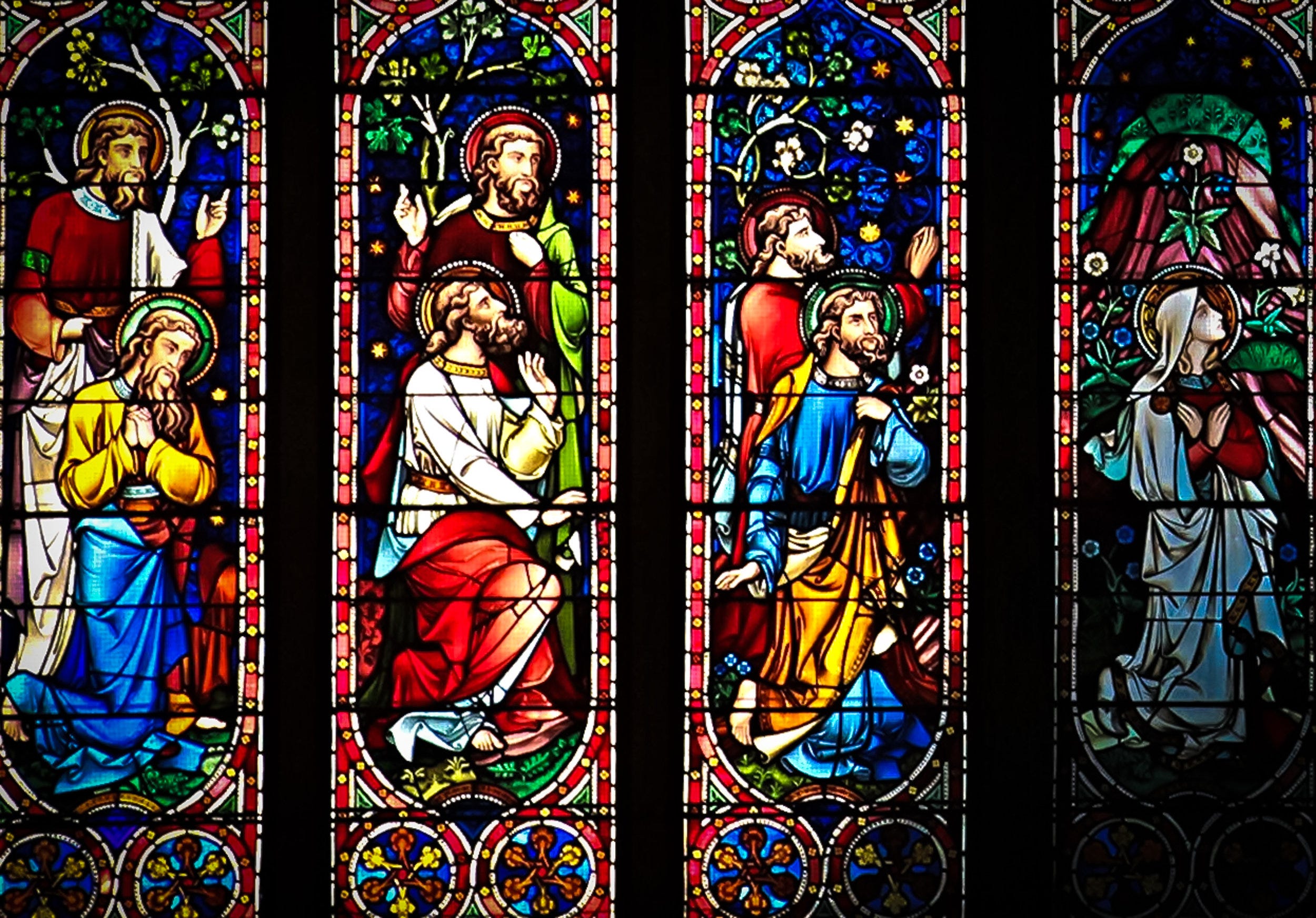
(Stained glass from St Patrick’s Cathedral in New York)
I’m not alone in my critiques of how St Patrick’s Day trivializes the experiences of Irish people and the long history of struggles around religion, ethnicity, language, and culture. Gerard Howlin’s article “Shallowness of Patrick’s Day brings home to us our lack of identity” in The Irish Examiner in 2014, for example, boldly states:
The problem is not the process, but that in selling ourselves we have largely lost sight of who we are. St Patrick’s Day is a universal celebration of Irishness and shallowness. With a national identity translated universally, we are left with little meaning except marketing. Irishness is now a connotation abroad, hollowed of content at home.
It was, until recently, very different. To be Irish was to be Gaelic and Catholic. These intertwined identities of religion and race set recognisable, if highly restrictive, boundaries to the nation. There was, of course, another interloping nation and identity on the island. But it was fundamentally foreign. The injustice of plantation was underscored by the apostasy of reformation. Even fundamentals change; but what is astonishing is how quickly ours have been forgotten, as well.
The Irish language and the Catholic faith were abandoned with alacrity. It is hard to think of comparable voluntary cultural evacuations, on such a scale, in such rapid succession, in another European country. For something as defining and identifiable as Irishness, it has proved to be extraordinarily disposable.
Bill Bigelow’s article “The Real Irish-American History Not Taught In Schools” for Common Dreams in 2019 observes:
Wear green on St. Patrick’s Day or get pinched.” That pretty much sums up the Irish-American “curriculum” that I learned when I was in school. Yes, I recall a nod to the so-called Potato Famine, but it was mentioned only in passing.
Sadly, today’s high school textbooks continue to largely ignore the famine, despite the fact that it was responsible for unimaginable suffering and the deaths of more than a million Irish peasants, and that it triggered the greatest wave of Irish immigration in U.S. history. Nor do textbooks make any attempt to help students link famines past and present. …
So go ahead: Have a Guinness, wear a bit of green, and put on the Chieftains. But let’s honor the Irish with our curiosity. Let’s make sure that our schools show some respect, by studying the social forces that starved and uprooted over a million Irish -- and that are starving and uprooting people today.
These issues are pertinent because they illustrate how hierarchical power works and how ethnicity can be bent and erased to serve its purposes. This is what moved Fintan O’Toole to write his Op-Ed “Green Beer and Rank Hypocrisy” in the New York Times in 2017, early in the first Trump regime:
Does green beer taste better laced with hypocrisy? Does shamrock smell sweeter perfumed with historical amnesia?
We may be about to find out, for this year’s St. Patrick’s Day jamboree at the White House will be a breathtaking celebration of double standards and the willful forgetting of America’s recent past. Even by the crooked yardstick of the Trump administration, the disconnect is surreal: The president will salute the legacy of one wave of immigrants even as he deploys against other immigrants the same calumnies once heaped upon the Irish.
In the blizzard of executive orders, it was easy to miss a proclamation President Trump issued on March 1. The president declared this Irish-American Heritage Month and called on “all Americans to celebrate the achievements and contributions of Irish-Americans to our nation with appropriate ceremonies, activities and programs.” The proclamation could hardly be more upbeat in its praise of the Irish for “overcoming poverty and discrimination and inspiring Americans from all walks of life with their indomitable and entrepreneurial spirit.” Mr. Trump embraced these poor and despised foreigners as the forebears of “the more than 35 million Americans of Irish descent who contribute every day to all facets of life in the United States.”
It’s not just the Irish, of course: over the last century and a half, many different ethnic groups attempted to “improve” their material condition by aligning themselves with the dominant White Anglo-Saxon Protestant social groups and turning their backs on their own ancestral traditions and by keeping other marginalized groups pushed down. This is how they changed their perceived racial category from non-white to white, and gained greater social cachet and political power. Italians, Poles, Greeks, Jews, and Lebanese are a few examples of ethnic groups who cultivated that transition in the past, and we can see it in the present with Latinos (many of whom form the rank and file of Immigration and Customs Enforcement and Customs and Border Protection) and people with immigrant ancestry from the Indian subcontinent (who have ascended into many governmental positions).
There seems to be a common pattern across marginalized groups to unconsciously suppress and bury stories about suffering, poverty, and injustice. They bring too much mental anguish, shame, and embarrassment to keep alive in communal memory. People would much rather celebrate their “achievements” – even if it means merely equaling or beating the dominant group at their own game, in their own way, and even if that means revisiting on others the abuse of power that they suffered in the past. This is a recurring pattern that I call “the chain of coloniality.”
It is important to be conscious of this suppression of history and to work against it. The first article I read that argued for the relevance of St Patrick’s Day was written by Celtic scholar Nerys Patterson and her partner Orlando Patterson, “St. Patrick Was a Slave,” published in the New York Times in 1993. They commented:
In America, St. Patrick’s Day is a quintessential ethnic celebration, highlighting Irish-American identity as not-British, not-Protestant, not-Italian or Polish (though Roman Catholic like these), certainly not-black or Jewish, and, in some quarters, not-homosexual. In these multicultural times, those of us who are not-Irish are encouraged to stand by the roadside cheering as the Irish parade their Irishness. We can do so knowing that, whatever our ethnic group, our moment will also arrive in the calendar of ethnic glory days that defines diversity in America.
To the salad-bowl multiculturalists, this is all there is -- and should be -- to America. From this perspective, St. Patrick belongs as exclusively to the Irish as Martin Luther King Jr. does to African-Americans and Columbus to Italians. The Irish alone have a collective patent on the interpretation of St. Patrick’s life and meaning.
There is, however, another version of the meaning of diversity for America, one that would reinforce its vibrant cultural center rather than balkanize it. This view denies any group a patent on its history, insisting that every American has the right to delight in, criticize and even claim the heritage of every group that interests him or her. It optimistically makes another claim as well: that once we know the fuller historical truths behind the ethnic myths, the heroes and struggles of other peoples become more meaningful and attractive. …
But the historical St. Patrick also has an equally important lesson for African-Americans and other minorities who feel they have been ill-used. Violent abduction, slavery, hardship and terror did not lead him into ethnocentric hatred of the Irish nor to a cultural relativism which complacently justified avoidance.
Dimly seen in his own writings, Patrick seems to have been a really great man, able not only to forgive his enslavers but to return to them with the challenge of his own creed. Before he could forgive, however, he had to be forgiven, which is what the British bishops did when they decided not to let the sin of his youth be a bar to his mission. In forgiving his former Irish oppressors, St. Patrick saved his own troubled soul, as well as theirs.
Shannon O’Sullivan’s article “Why Irish Americans Should Embrace Their Culture of Colonial Resistance” for Yes magazine in 2018 makes a similar argument:
“What we’re really conscious of, and what I’m really conscious of, is that quite a number of Irish Americans surround Trump,” Ó Ríordáin said. “These are all people that in my judgment have completely forgotten their family history … We were once the people who came to America as refugees. We were viewed by the British as being terrorists. We were people who suffered sectarian discrimination in the United Kingdom and [in the U.S.], as well.”
Given the seemingly conflicting narratives of Irish America, what is it really to be Irish American and then to ethically celebrate Irish heritage?
It could appear that most Irish Americans have recently and mysteriously forgotten their own ancestral oppression. But the more complex reality is that Irish American identity and political consciousness have always been shaped by intersecting social forces, including colonialism, capitalism, religion, and racial formation, which have produced both cohesion and division. …
I urge Americans of Irish descent to collectively revisit and deepen their understanding of the colonial and oppressive conditions that produced the Irish diaspora. I advocate for St. Patrick’s Day to become a day of remembrance of Ireland and Irish America’s intertwined historical experiences of oppression. Perhaps consider organizing an “Irish Stand” like the one in New York City, an occasion of resistance to colonial and oppressive systems across ethnicities, races, genders, and classes, rather than the typical event with green beer, corned beef and cabbage, and shamrock decorations.
The pages of Gaelic history offer relevant material that can illuminate the human predicament where power and injustice are concerned, not to mention the simple clash of culture. I’ll offer one further example of this nature from my own research about Gaels who travelled to North America, mostly as immigrants but sometimes as curious travellers.
St Patrick came to be remembered and represented in the Gaelic literary tradition shared by both Ireland and Scotland as a transitional figure between the old pagan world and the new Christian one. This transformation was not always seen as a welcome or wanted one. The song-poetry about the Fianna, for example, depicts them as the stalwarts of the old order and the last of them – Oisín, Oisean, or “Ossian” – meets St Patrick in his old age and defies the holy man’s attempts to convert him. Ossian reminisces glowingly about the old days and defies the Christian mission of salvation. One of the alarming aspects of the new doctrine was that it condemned those who were not Christians to Hell – including one’s own forebears, which is a terrible sentiment for those who revered their ancestors and ancient gods. In fact, the early Gaels devised ingenious loopholes to find a means of redemption for them, as John Carey comments in his short book A Single Ray of the Sun.
Patrick Campbell was a Highland gentleman from Argyllshire who took a trip to North America in the years 1791 and 1792. During his journey, he visited a group of Mohawks who had fought alongside Highlanders during the Revolution, including the celebrated soldier Joseph Brant. Campbell’s notes demonstrates how a knowledge of Gaelic history could inform perceptions about the experience of native peoples by offering them parallels with their own inherited tradition:
With Captain Brant I had a conversation upon religion, introduced by him, indeed, and not by me. He said, that we were told every one that was not a Christian would go to hell; if so, what would become of the miserable souls of so many Indians who never heard of Christ? asked if I believed so, and what I thought of it? I told him very frankly, that if all the saints and priests on earth were to tell me so, I would not believe them […] but his discourses brought to mind a conversation on traditionary record, that passed between Ossian the son of Fingal, and Patrick, the first Christian missionary he had seen.
The problem is not actually St Patrick himself. He lived over a millennium and a half ago. He’s long since gone. We can try to recover whatever evidence might survive that relates to his life and try to make sense of it in our own way. And the same holds for the lives and experiences and expressions of those many millions of others who have called Ireland “home.” And this is the problem with the whole endeavor called “history”: it’s not that “it speaks to us,” to repeat a common cliché. Instead, we create a kind of dialogue with it, through a lens darkly, highlighting the significance of some issues and ignoring others, largely because of what we think is relevant or interesting from our own point of view. This is why the way that we interpret and discuss history is always changing: not only does the available evidence tend to increase, but our own perspectives in the lived present are constantly shifting and giving us new priorities and imperatives.
I’m not going to try to tell people how to behave or what not to do, but if you think that the history and identity of people – whether marginalized or dominant – deserve to be treated with respect for what it can tell us about the human experience, and our past and present, St Patrick’s Day deserves more than the cliches that usually define it.
That, in a nutshell, is why I try to go to the Capital Irish Film Festival every year. Last weekend‘s 42 films offered a rich array, in both English and Irish, of reflections on past oppression and conflict, current challenges, and the simple richness of life. No green beer in sight.
This important post is relevant on this side of the Atlantic too! Its insights could transform understanding of what happened to our Celtic nations. They could also transform our attitude towards migration and migrants today. And they could transform future policies around salvaging and developing our languages and culture. All of which begs the question: how can we circulate the information so that it sparks the public discourse?