
Exploring Celtic Civilizations
An introduction to some of the foundational concepts of Celtic Studies

Back in 2010-2012, I taught a course entitled “Celtic Civilisation.” It was meant to be an introduction to the concepts of Celtic Studies and a summary of some of the historical and cultural highlights of Celtic-speaking people. The problem is that there is not really a suitable textbook for a college-level textbook on the topic (Celtic Studies as a field is very under-resourced). Naturally, I started writing my own. I didn’t have the time or support to finish what would have been a very challenging project requiring another collaborator or two, but I did produce a lot of useful material.
I put most of it on a WordPress website that was hosted by the University of North Carolina, Chapel Hill, for several years, but that eventually became obsolete. Since many people have sent me messages of appreciation for the work and requests to restore it, I’ll be sharing some of the material on this Substack blog, starting with the introduction to the volume.
Exploring Celtic Civilizations is an online coursebook suitable for undergraduates introducing the field of Celtic Studies: the various kinds of evidence available about Celtic-speaking communities through over two millennia and the methods available for understanding them.
Coursebook Design Principles
The materials in this digital coursebook – both primary sources and expository units – have been created with the following design principles:
Accessibility: Sources need to be comprehensible to undergraduate students without prior training in specialized terminology or detailed background knowledge of any particular discipline. They are, therefore, given introductory notes but not complicated by excessive footnotes and parenthetical asides.
Active Learning: Rather than provide all possible conclusions and interpretations, reading exercises are provided for group discussions which invite readers to apply analytical methods to primary evidence.
Interpretative Lenses: The coursebook suggests a set of overarching interpretative lenses, or themes, to facilitate group discussion of all readings.
Why a Celtic Civilization Course?
Celtic Studies is a highly multidisciplinary endeavor, drawing upon such diverse fields as history, historiography, archaeology, paleography, linguistics, anthropology, art history and sociology to identity and interpret the remains of the past (and conditions of the present) as they pertain to Celtic-speaking communities over a very long time period. These exercises in analysis have broad applications to other contexts and evidence.
Celtic Studies is a subject worthy of investigation in its own right, however, especially given the increased attention to and interest in the impact of empire across time and space. Celtic peoples are seldom given credit for their contributions to European or world civilization and there is seldom adequate discussion of how the ideologies and practices of colonization developed to conquer and dominate Celtic peoples were transferred overseas in the expansion of Anglo-British power.
Although there are university-level coursebooks covering the topic of “Western Civilization,” the contributions and even existence of Celtic peoples in those histories is seldom well represented or investigated. It is commonplace for Romans and Anglo-Saxons to be lauded for innovations or contributions which were first accomplished by their Celtic neighbors. It is particularly ironic that a very significant number of the audience for these coursebooks in North America are descended from Celtic peoples whose existence is largely silenced and obscured by mainstream historical texts, produced and enshrined at the height of anglocentric imperial power, except to play the part of rebels and barbarians waiting to receive the “benefits of civilization”.
Empires have inflicted immeasurable damage and injustices around the world and critiques of empire have been growing more articulate and passionate. University-level courses about trans-Atlantic or global history attempt to represent a diversity of voices and reflect (rather than hide) how the domination and exploitation of empires have devastated indigenous and subaltern peoples, not to mention natural ecosystems.
Those who cover these issues as they relate to North America, however, can easily neglect to understand or discuss how the strategies and habits of British imperialism in the “New World” were extensions of centuries of practice on Celtic neighbors, even if they were reshaped in new geographical and ideological contexts. It is impossible to understand fully the social history and cultural trajectory of Celtic peoples in the modern period without taking into account their relationship to British and French empires. The descendants of Celtic peoples displaced by and embedded in colonial processes need the tools and resources to understand this history from something other than an anglocentric perspective.
What should we ask?
The title of this coursebook refers to “Celtic Civilization.” This title invites us to ask fundamental questions about early peoples labeled as Celtic, the nature of their societies, and the “baggage” we bring when we try to interpret them:
What commonalities are there that allow us to speak of societies widely separated in space and time – Iron Age chieftains, the Roman-era colony of Galatia in Asia Minor, and the medieval Irish, for example – as all being “Celtic”? How can we identify and characterize Celticity?
What do we mean by “civilization”? Does it refer to specific features, or is it merely an arbitrary or subjective label?
How do our modern stereotypes obscure our ability to understand radically different societies? How, in specific, does Celticism colour our perceptions of Celtic peoples and their cultures by projecting assumed qualities and traits onto them?
Each of these questions requires applying different kinds of methods.
Celticity
Celticity refers to the actual traits and features – social structures, practices, values, styles, motifs, beliefs, and institutions – of a particular society which makes it Celtic. Needless to say, there must be some set of traits and features common to numerous peoples in order to call them “Celtic” in any meaningful sense: if there is not, the idea that various peoples – the ancient Gauls, the Galatians of Asia Minor, the Irish, the Celtiberians – are all Celtic is only an illusion (whether of the ancient or modern imagination is a matter of great debate).
There are different categories of evidence for the prehistoric period, and each of these has strengths and weaknesses. Many Celtic scholars argue that the most important test for Celticity is language: a group of people can be definitively labelled “Celtic” if they speak a language in the Celtic language family. Not only are the Celtic languages the most tangible markers of a common Celtic heritage, but language itself is a carrier of culture and helps to provide the categories in which people experience and understand the world. Language is not merely a collection of words and grammar – those words contain bundles of meanings and concepts which influence our thoughts and reflect the values and structures of society. Linguistic evidence is not always available, so we must often examine other kinds of evidence and compare it to that of other regions considered to be Celtic.
Demonstrating Celticity conclusively is a complex task, for we must decide which features or traits are essentially Celtic – fundamental aspects of being a Celt. This means doing comparative research carefully and being careful about oversimplified assumptions and stereotypes. For example, although we know that the (ancient) Celts loved wine (given material artefacts alone!), so did other peoples in the ancient world! Evidence of fondness for wine alone does not indicate evidence of Celts or Celticity.
Civilization
In this book we will use, and distinguish between, three major usages of the term “civilization,” from the most informal to most specific:
In an informal, colloquial way, it is used to characterize the general nature or character of any particular society taken as a whole (e.g., “Greek Civilization,” “Mohawk Civilization,” etc). This is the least specific and least useful usage of the term “civilization.”
In a “technical” sense, it is used by historians and archaeologists to describe societies characterized by their complexity and stratified and specialized social roles. The list of traits of civilization was first enumerated by Gordon Childe in 1950 and has been expanded by others since then. It includes:
(1) large urban centres, (2) craft workers, merchants, officials, and priests supported by the surpluses produced by farmers, (3) primary producers paying surpluses to a deity or divine ruler, (4) monumental architecture, (5) a ruling class exempt from manual labour, (6) systems for recording information [i.e., literacy], (7) the development of exact practical sciences, (8) monumental art, (9) the regular importation of raw materials both as luxuries and as industrial materials, (10) peasants, craftsmen, and rulers form a community, (11) the social solidarity of the community is represented by the preeminence of temples and funeral cults, and (12) a state organization is dominant and permanent. (Bruce Trigger, Understanding Early Civilizations, 43.)
While people in ancient times would have recognized these features as aspects of civilization, they typically used the term in an intuitive and looser way, thinking of a set of stages of “refinement” from the supposedly “primitive” origins of the animal world: urbanized societies exploiting agriculture; increasingly ordered and hierarchical social structures; technological advancement; the mastery of reason and rationality over emotion. We must, however, also recognize that any person is likely to consider as “advanced” or “civilized” any society which resembles their own.
“Civilization” is also typically used in political rhetoric when one particular society attempts to impose its power and authority over another society and expresses its claims as to why its inherent superiority gives it the right to rule others. This has happened many times in history, such as when Roman, Chinese, French, or British empires have expanded into foreign territory. This almost inevitably involves invoking meaning (2) of civilization:
The word civilization evokes powerful images and understandings. We [are] taught, from elementary school onward, that a few ancient peoples – like the Egyptians or Greeks – were “civilized” and that civilization achieved its highest level of development here and in other Western countries. Civilization, we are told, is beneficial, desirable – and definitely preferable to being uncivilized. The idea of civilization thus always implicitly involves a comparison: the existence of civilized people implies that there are uncivilized folk who are inferior because they are not civilized. Uncivilized people, for their part, have either been told that they can never become civilized or that they should become civilized as soon as possible […]
Civilization, as we have seen, always involves hierarchically organized social relations and cultures. A civilization is a class-stratified society that “civilization originates in conquest abroad and repression at home.” Its rise is ultimately linked with the formation of social classes and a state apparatus. As part of the civilizing process, the politically dominant groups strive to distinguish themselves socially and culturally, both from classes that their members have subordinated at home and from communities beyond their frontiers. They portray their own members as refined, polished, and cultured; members of the subordinated classes and external communities are depicted in oppositional terms as uncivilized, barbaric, crude, rustic, wild or savage. The precise characterization is historically contingent, varying from one civilization to another. (Patterson, Inventing Western Civilization, 9, 87.)
Class Discussion
Read the following for what they say about the idea of civilization: How do these writers reflect their own biases about what they see as the differences between civilization and barbarism, and where they see themselves and the ancient Celts in that “hierarchy of societies”? Were the ancient Celts seen as changing or capable of “progress”?
Ammianus Marcellinus, Rerum Gestarum §15.11
Diodorus Siculus, Library of History §5.22
Polybius, Histories §2.17
Tacitus, Agricola §17
Celticism
Celticism is a system of stereotypes that has been projected onto the Celts by outsiders, especially within the context of the Roman and British Empires. Celticism impels us to prejudge the characteristics of Celtic societies based on a particular set of expectations, imposed from outside of Celtic societies themselves, rather than understanding them from an internal context and perspective. These stereotypes were established in the texts of Classical Antiquity and were picked up and reiterated into the modern era.
Just as racism is not just a random bundle of stereotypes but a coherent and inter-related set of ideas, Celticism does not just refer vaguely to stereotypes about the Celts but consists of distinct and interlocking aspects. Celticism is:
a set of claims about the differences between civilization and barbarity
expressed as a set of opposing and essential qualities and traits
projected by non-Celts from the outside upon the Celts as a whole
used pervasively as a lens to “interpret” the culture, history and character of Celts
similar if not identical to those used by empires on other subjugated peoples
Some of these traits can be characterized by the schema below:
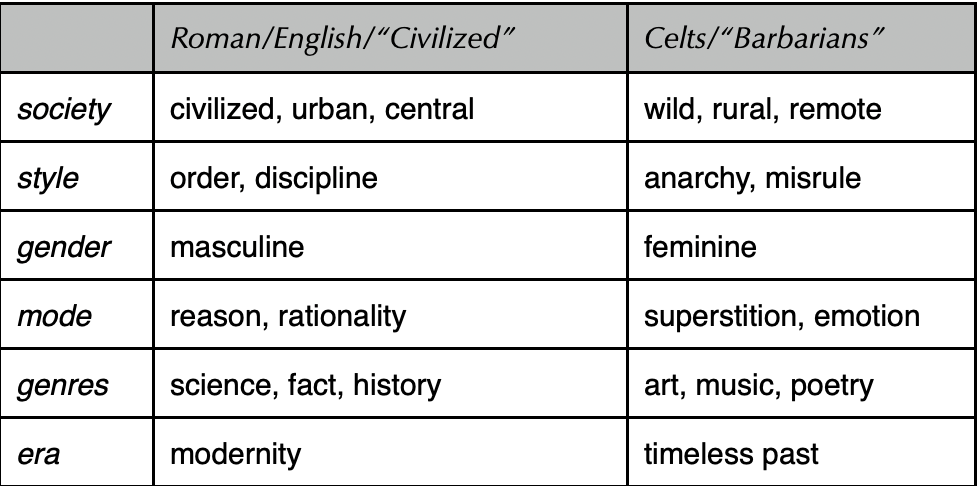
This set of stereotypes is not unique to the Celts: similar sets of prejudices seem to recur commonly in the justification of power hierarchies; in other words, many different élite have reinvented similar claims of being more advanced and civilized than the people that they repress in order to justify their dominance.
Class Discussion
What other people might we substitute for “Celts” in the scheme above to reflect familiar prejudices and rationalizations of conquest and colonization?
Data and Evidence
In order to study any historical era, we need data on which to base our analysis. Different kinds of data lend themselves to different kinds of analyses. The next several units in the textbook will cover several kinds of evidence, how the evidence is found and interpreted, and what its strengths and limitations are: historical documents, linguistics, inscriptions, ethnonyms, and archaeology.
Critical Thinking
Keep these approaches in mind when engaged in any exercise of analysis or interpretation:
Stick to the facts! Research should not reflect personal biases (yours or any other else’s). Be careful about falling into the stereotypes and traps of Celticism!
Be skeptical! Where does your evidence come from? Was this evidence created to advance someone’s personal (or familial) interests? Could the evidence have been tampered with? Whose perspectives or biases does it convey? What is the line of transmission of that information?
Be specific! Put everything in the context of the people, place, and events that produced it, as that context shapes the information and may be the reason that it exists at all. This contextual information is usually key to interpreting not only what is said but how it is said.
Course Critical Concepts
You can return to the key concepts introduced in this section (and those that follow) at the end of class every day, asking a set of questions about the material that was presented. These questions challenge us to analyze our course content at a high level of abstraction and to create connections across class sessions:
How does today’s material relate to one of the three definitions of “civilization”?
What aspects of Celticity can we see in today’s materials? How does the material connect different Celtic communities separated by space and/or time?
How would Celticism confuse us about the reality of today’s material? How can we separate facts from modern fictions?
This so dense (forgive me!) that I have had to return to it and re-consider it in the light of the substack posts so far. Not only does it establish helpful principles for cutting through our (usually blind) prejudices where Celtic Studies is concerned, it also gives us insights and tools for understanding the world more widely. In so doing, it dovetails with complementary initiatives such Empire with David Olusoga, currently airing on the BBC. Looking forward to the publication of what will surely be an educational resource that deserves pride of place on the shelf of every serious student of Dùthchas Ceilteach and the more general principles of Anthropology…
This is great; so accessible. Needs to be taught in our school system. Mìle buidheachas a charaid.