
COP26 in Scotland
Scottish reactions to the challenges of a more just and sustainable way of life and being in the world

Originally written on 18 October 2021
On Samhain (31st October), Glasgow will become the host for the UN Climate Change Conference. Our ecological crisis has never stared us so clearly and cruelly in the face, and there has never been more urgency, at least in some quarters, to do something about … despite the continued denial and resistance from those élite who profit from fossil fuels. (See details about COP26 at this link)
The summit gives Scotland the spotlight for a brief moment, so it represents a unique and rare opportunity for Scottish voices and perspectives to be heard on ecological issues. How are Scots rising to this occasion and making a contribution to this global conversation?
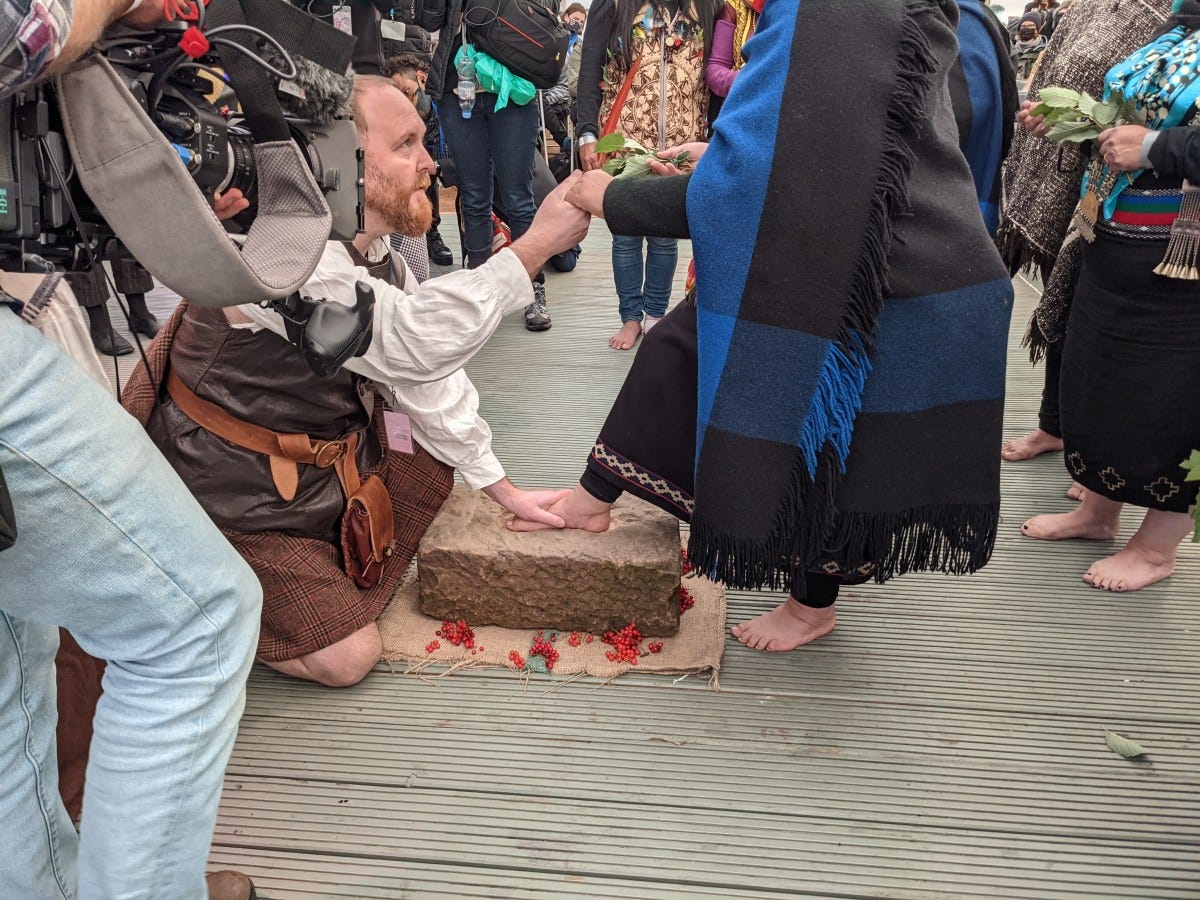
(Image of Àdhamh Ó Broin and family greeting indigenous elders to COP26 with ritual)
It should be no great surprise that my friend Alastair McIntosh, who lives in the greater Glasgow area, has continued to engage in these issues and explore how this crisis is essentially a spiritual one. That is the culmination of the message of his latest book, Riders on the Storm. After going through the scientific analysis of green house gases and other physical factors influencing the natural world, he then probes the inner, psychic realms, with a special focus on the Scottish Highlands. “Climate change is a ‘spiritual crisis’ because it is driven, foremost, by the inner life emptiness that underlies consumerism,” as he noted on Twitter (6 Oct 2021).
Native communities everywhere have been undermined by groups bent on domination who often justify their monopoly on political power with the values of materialism. Natives are supposedly unable to exploit the untapped resources at their feet, unable to develop their potential properly, are in need of improvement so that they can enjoy a “better standard of life,” and so on. This clash of values and ideologies has long been noted, but one of the most forceful articulations of this issue in a Gaelic context is the essay “Real People in a Real Place” by the Lewis poet Iain Mac a’ Ghobhainn in 1982.
Is it possible that far from the world of the islands being archaic it is a model of a world which might return, though not exactly in the same form. The individual cannot go on forever bearing his alienation and abstraction: for if he will not find a true community then he will find a false one, like the National Front or some other organisation. For it is clear that the returning exiles who may appear comic are seaching for that which they have not found, meaning a home, materialism having left them in the middle of the wood in darkness.
The attack on the island world both internally and externally was based on the values of materialism, and now that the possessions and treasures have receded, perhaps forever, such a criticism might seem at the least short-sighted. To learn French in order to enter the ranks of the unemployed is a real paradox. (p 43)
How, then, we do critique this materialistic triumphalism and revitalize the roots of communities that have been undermined by seemingly insurmountable forces for generations? Surely arts, culture, and spiritual roots are vital to ground such work and to provide a new vision toward the future.
In an important blog post about reconstituting community and roots in the land through cultural and linguistic revitalization, and the central role of Gaelic in these efforts in the Highlands, Màiri McFadyen argues “All politics on its own can do is to react or cope with the current situation; the artist articulates, expresses and thinks confidently about who we are and who we could be.”
A program of presentations under the aegis of the Dear Green Bothy is one way in which Scottish experiences are being shared with the world. (The name of the forum is a nod to a common popular interpretation of the older Celtic meaning of Glasgow, “Dear Green Place.”) One of the presentations in the series focuses specifically on the chthonic goddess who was known by several different names in Gaelic tradition, but who we could call generically A’ Chailleach. This presentation, involving Gaelic scholars, singers, and artists, describe it thus: “Dear Green Bothy’s A’ Chailleach The Cailleach will question how respect for traditional knowledge and engagement with wilderness, can inform action to the climate crisis being addressed by COP26.”
Maybe it’s just a coincidence that this summit will commence on arguably the most important date on the Celtic ritual calendar, a day associated with the ancestral dead, with the turn to the dark half of the year, and the Otherworld forces. Let us hope that this will aid those involved in their spiritual activism. To quote McIntosh (from the blogpost at this link) once again:
Do what you are doing because it is right. Do what you are doing out of integrity. And whether it succeeds or fails is a lesser question. What happens is that when you do that, you start to draw spiritual help to you, and sometimes things succeed in ways you would never have expected. But don’t let that be the objective. Let the objective to be faithful to the truth of life. That’s spiritual activism.
You and Alastair, who is a mutual friend, are correct in stating that the most important objective in life is to be faithful. It is also true that so much of what is happening in the world today is revealing the bankruptcy of western materialism. Your work in recovering the richness and relevance of native cultures is timely and fortuitous. Tapadh leibh, an dithis dhuibh.